





Breakthroughs
In Alzheimer's Research
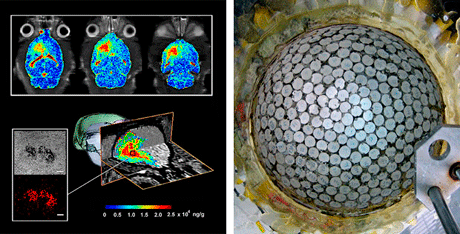
Images: Hao-Li Liu/Chang Gung University
Window In The Brain: A 256-channel ultrasound array could electronically steer ultrasound energy to open the blood-brain barrier and allow medicine to enter the brain.
Ultrasound May Make It Possible To Treat Alzheimer's In A New Way
By Gretchen Heuring 6.4.2014
Engineers at Chang gung University, in Taiwan, have designed a device that sends tiny beams of ultrasound into the brain, allowing drugs to get through something called the "blood-brain barrier."
The blood brain barrier is a protective device created by our bodies. Currently most drugs available for Alzheimer's therapy have large molecules that cannot pass through the blood brain barrier. This new ultrasound device opens the barrier enough to allow these important drugs to pass through. This may be a way to fight Alzheimer's Disease and some other central nervous system diseases.
Professor Hao-Li Liu and his team have devloped a circuit design that delivers two frequencies at once. This is a new idea and quite different from ultrasound machines that we have now. Current devices deliver only one freqency. Two allows modulation and that is key to the progress this team of researchers has made.
Though there is more work to be done with neurologists and clinical trials, this looks very promising.
From IEEE Spectrum 5.2.2014
| Watch this presentation featuring Phil Iredale, Head of Neurodegeneration Biology at Pfiser. Dr. Iredale addresses many of the basic questions that are key to understanding this challenging disease. |
Researchers in the U.S. and around the globe are searching for ways to prevent and cure Alzheimer's Disease. Many believe that understanding the cause of Alzheimer's will provide valuable clues to prevention and treatment.
Some research directions have resulted in dead ends. Others have introduced more questions than answers. Overall, there is slow steady progression in the research communities.

A New Test For Alzheimer's You Can Take At Home
Ella Traver for ElderThink
Yes, the rumors are true. There is a new test for Alzheimer's Disease that you can get online and take at home. Researchers at Ohio State University have developed the test. It's called SAGE (Self-Administered Gerocognitive Examination).
As with all new things, there is a caution to consider. If the test results suggest cognitive impairment, it might not mean you have Alzheimer's. There could be another cause such as depression or hidden heart disease. So if, when you take the test, indications are revealed, for goodness sake head for you doctor!
 |
GET SAGE TEST |
Blood Test Predicts Alzheimer's Disease
Researchers at Georgetown University have developed a blood test can accurately predict the onset of Alzheimer's Disease. Experts said the results needed to be confirmed, but such a test would be "a real step forward". Read more about this new discovery.
|
BLOOD TEST |

Discovery Could Lead To Drug That Halts Neurogenerative Diseases Including Alzheimer's
Gretchen Heuring for ElderThink
Investigators at Southern Methodist University and The University of Texas at Dallas have discovered a family of small molecules that shows promise in protecting brain cells against nerve-degenerative diseases such as Parkinson's, Alzheimer's and Huntington's, which afflict millions.
Dallas-based startup EncephRx, Inc. was granted the worldwide license to the jointly owned compounds. A biotechnology and therapeutics company, EncephRx will develop drug therapies based on the new class of compounds as a pharmaceutical for preventing nerve-cell damage, delaying onset of degenerative nerve disease and improving symptoms.
Treatments currently in use don't stop or reverse degenerative nerve diseases, but instead only alleviate symptoms, sometimes with severe side effects. If proved effective and nontoxic in humans, EncephRx's small- molecule pharmaceutical would be the first therapeutic tools able to stop affected brain cells from dying.